
Original or Fixie?
Same patented lock. Two opposite ways of putting it to work. Here's the real difference, in as much detail as you want.

The vintage Jazzmaster idea, made durable. Saddle grips the string and moves under vibrato - locked in place, not held by a weak spring.
Shop Original →
The chassis is clamped straight to the body. The saddle stays locked while the string slides freely across it - maximum rigidity, maximum sustain.
Shop Fixie →Don't want to read the whole page?
The entire decision, at a glance. Everything below goes deeper into why - here's the TLDR:
Rocking
- Vintage rocking feel and float, brought up to date
- Best if you use the vibrato heavily - perfect floating return
- High-friction saddle grips the string for zero abrasion
- Performs best with traditional offset hardware and a balanced, shallow break angle
Fixed
- Maximum sustain, most direct attack
- Excellent vibrato return, especially with lighter strings
- String slides across a fixed low-friction saddle
- Won't walk or lean under a steep break angle, but shallower angles will return to pitch better
Still torn? Keep scrolling for the full mechanical case.
Using the whammy bar forces the string to move.
A rocking bridge will keep perfect tune no matter how much or how hard you use the vibrato - as long as the saddle's static friction coefficient prevents slippage. That's because the saddle holds tightly onto the string, and pulls in alignment with its frictionless rocking axis.
A fixed-post bridge is held fixed relative to the guitar body, not the contact patch with the string. When you use the vibrato, the string must brush over the saddle. It will keep great tune as long as the dynamic coefficient of friction is minimised.
Rocking and fixed aren't two types of the same thing. They're opposites.

The string moves. The bridge follows.
High friction keeps the string and saddle moving as one surface — near-zero abrasion, because nothing is sliding against anything. The lock only has to hold that grip in place; the rocking geometry already absorbs the rest.

The chassis stays put. The string slides over.
The saddle can't rely on the bridge accommodating the string, so it doesn't move at all — the string slides across a PVD coating instead. Harder job for the lock, in exchange for total rigidity.
Decided already?
You don't need to read the whole page to know which one you want.
Same lock. Different trade-offs.
Neither bridge is "better" — they're built for different priorities. This is where they actually diverge.
As we hear it - a guide to feel, not a frequency measurement.
The difference holds up at any distance.
Step back and they look almost identical. Step in, and the two philosophies pull apart.
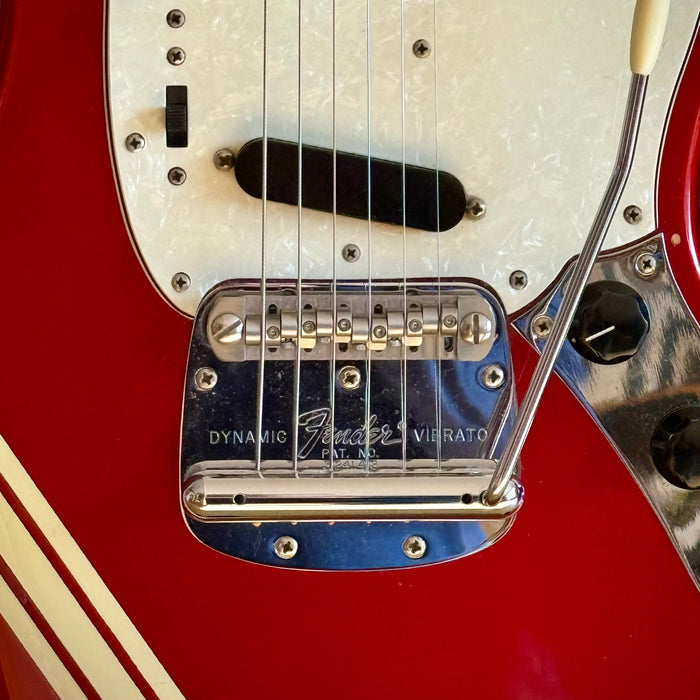
Rocking action, using your existing thimbles. No modification.
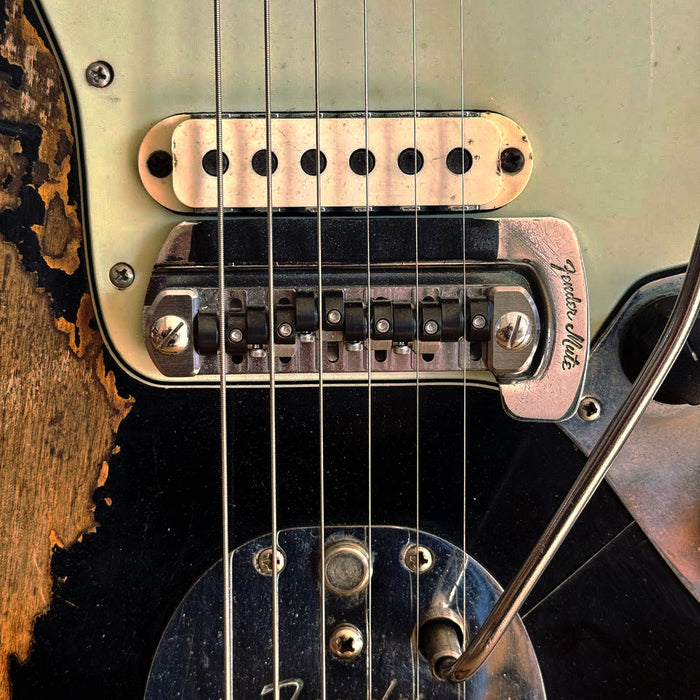
Fixed chassis, clamped straight into thimbles via CoreClamp.
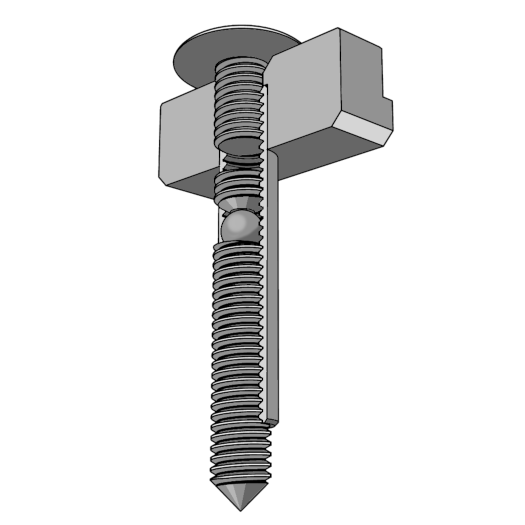
A hardened steel bearing eliminates torque transfer - no play, no rattle.
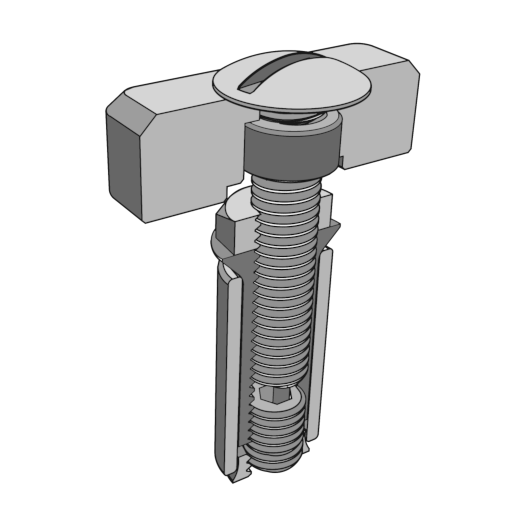
Clamps directly into the thimble — nothing left to rock.
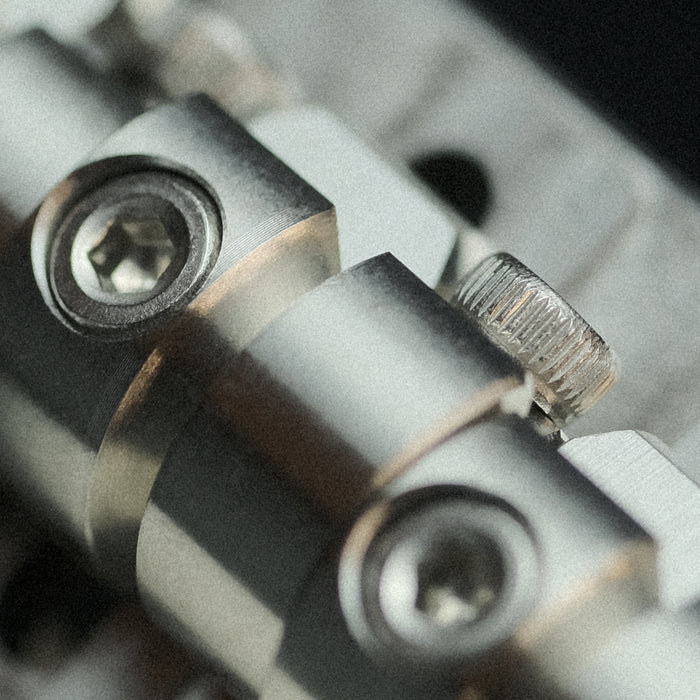
Grips the string firmly under load.
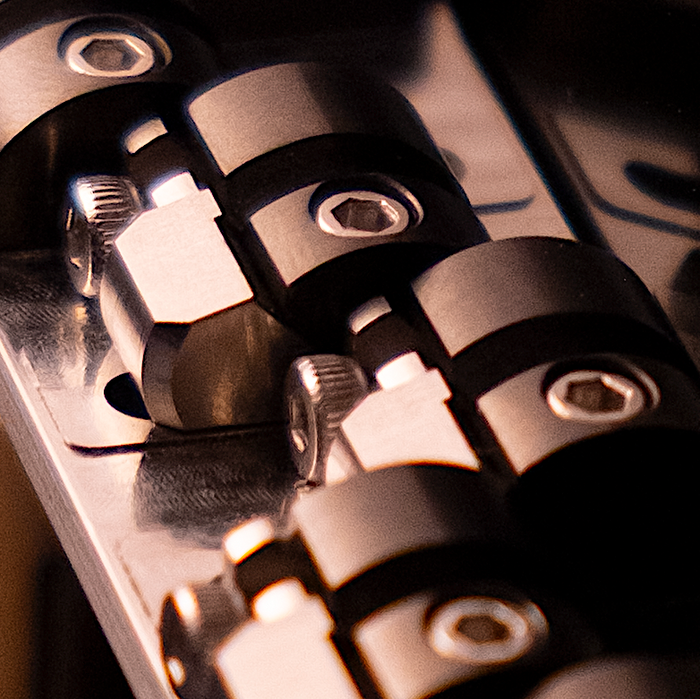
Shallower angle, PVD-coated — built for the string to slide, not grip.
Rocking and fixed bridges make different demands of surrounding hardware and setup, and we've engineered a specific design for each. The charts below are a rough guide to those relationships, not measured data — useful for diagnosing an issue or getting a feel for the right shim angle, whichever bridge you're running.
It tightens the attack. Every Tuffset just needs less of it to begin with.
Nothing here depends on downward pressure to stay locked. But once you get to a certain point, all the extra angle is added behind the bridge, and this can sometimes unbalance a rocking bridge.
Same lever, opposite effect: heavier strings help rocking bridges grip harder - but the same heavier strings can sometimes work against fixed-posts, which like minimal friction. Some strings have a slick coating that prevents corrosion. These coatings can sometimes destabilise a rocking bridge, or improve the tuneholding of a fixed-post.
 center center;
Everything, side by side.
| Original | Fixie | |
|---|---|---|
| Post system | Rocking post, Bearing Lock | Fixed post, CoreClamp |
| Saddle friction | High-friction | Low-friction, PVD-coated |
| Finishes | Stainless · Brass | Black Ice (DLC) · Chrome Frost (CrN) |
| Intonation Range | 11mm · | 11mm |
| Neck radius | Adjustable between 5-3/4″ and 22" | Adjustable between 5-3/4″ and 22" |
| String spacing | 52mm | 52mm |
| Max string gauge | .068 (Original) .120 (WideBoy) | .120 |
| Install | ~15 minutes, drops into existing thimbles | ~15 minutes, drops into existing thimbles |
| Price | £219.00 | £239.00 |
| Best for | Heavy vibrato use, vintage-correct feel | Maximum sustain, direct attack, normal vibrato use |
Which one fits your setup
Bigsby Telecaster, or anything with a sharp retainer bar
It's not the Bigsby that matters - it's the break angle it creates. A B5's stock retainer bar sits steeper than a rocking bridge wants. If you're using the vibrato heavily, we'd point you to the Original - but if you can remove or replace the retainer bar for one that sits a bit higher, that's ideal.
A Fixie with a sharp break angle can sound really beefy and won't collapse, but won't keep tune quite as well as a shallower setup.
Bass VI or Baritone
Both bridges handle low-B and low-E gauges without issue. The Original needs the WideBoy upgrade for strings heavier than 0.068 gauge; the Fixie's standard slots are already wide enough to handle up to 0.120.
Standard size Jag mute is compatible with both Fixie and Original WideBoy.
Intonation adjustment per string, and with almost double the range of a standard bridge - perfect for alternate tunings.
Jaguar Mute
Both models of Tuffset Bridge are compatible with a Jaguar mute without modification, though it might affect the minimum profile of the bridge.
What about Hardtails?
We certainly recommend the Tuffset Fixie if you've replaced your vibrato with a hardtail plate, or are running into a stop tailpiece. High friction saddles available on Fixie by special request - please enquire.
14-day returns, and often a straight swap
If the Original doesn't suit a particular guitar's geometry, we'll often suggest exchanging it for a Fixie rather than just processing a refund.